


Fast verification mitigates the risk of running bad parts and losing profits to wasted time. Proper inspection fixturing is essential for efficient and accurate measurement, as well as for overall quality control and productivity. Below are the key considerations to keep in mind:
Profits Are in The Speed of the Swap!
The faster you can swap between parts, the more profitable the process becomes. Modern inspection machines and software are more effective than ever, but only when the machine is actively running. If the machine is idle during fixturing and setup, ROI is reduced, shop floor production is delayed, and profits quickly evaporate. Thinking outside the box and embracing modular fixturing and associated CAD models can significantly enhance efficiency. Eliminate waste that was once accepted as “cost of doing business” – therefore, uncovering hidden profit.

Ensuring Repeatability and Reproducibility
Repeatable: Achieving the same results with the same fixture and operator – without changing the setup.
Reproducible: Achieving the same results after the fixture is removed and a different operator sets it up again.
Proper fixturing secures parts in a consistent orientation during measurement, reducing operator error, and part movement or part distortion. You want consistency that ensures that inspection setups are repeatable and reproducible across multiple runs, shifts and operators.
Click the links below to check out Video Content and Case Studies for quick, practical tips and real-world success stories on using Inspection Arsenal® products.
Video Content:
https://inspectionarsenal.com/video-library/
This Video Library provides a time study, custom fixture information and product information as a guide to understanding the use and benefits of Inspection Arsenal®. Encouraging creativity and demonstrating how reproducibility can be maintained across different inspection requirements, these videos are lean-focused, showcasing efficient workflows with minimal waste.
Case Studies:
https://inspectionarsenal.com/case-studies/
These articles provide practical examples of how Inspection Arsenal® products are applied in real-world manufacturing settings to ensure precision and consistent results.

Maximizing Efficiency and Reducing Downtime
Quick swap fixturing allows for off-line design, setup, and programming, that can eliminate machine downtime. With quick swap fixturing, the next part fixture can be set up and loaded independently from the machine, while the machine is still running previous parts. This reduces overall time lost and increases throughput as fixtures are removed and installed with the click of a magnet – usually faster than it takes for the program to load. Large runs can slow things down due to the time it takes to unload and load parts. Using two identical fixtures can speed up the process by letting the machine inspect one batch while the operator unloads and reloads the next batch at the same time. Often, when parts are queued for inspection, shop floor machines are sitting idle, (or continuing to run at risk) while waiting for inspection data. Speeding up the inspection process means faster feedback to the shop floor, improving the efficiency of the entire manufacturing process.

Cost and Time Savings
Quick swap fixturing saves time and money by eliminating the need for improvised setups and freeing inspectors from having to wait for machine downtime to break down and develop fixtures for the next part. By streamlining changeovers, you can lower operating costs, including payroll and daily overhead, while boosting throughput—keeping expensive machines running, preventing costly delays, and maximizing the use of resources.
Flexibility in Design
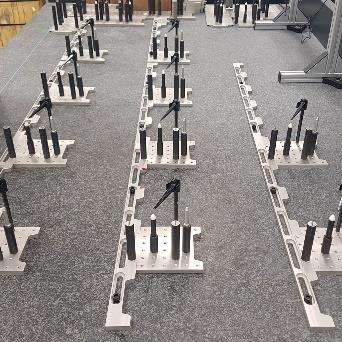
Whether you are inspecting prototypes and “onesie twosie” parts or high-volume repeat work, modular fixturing can be employed for various part types and reused across different applications. Treat modular fixturing as an “erector set” where the only limit is your own creativity. Dedicated fixtures should be designed for high-volume production, but dedicated fixtures developed from modular components mean that fixtures no longer go to waste when a part becomes obsolete. Components can easily be broken down and reused in future fixtures.
When selecting plate sizes, it’s important to accommodate the part and NOT the machine. The outdated way: Our machine is “this big”, so we need a fixture plate “this big” to fit on it. The Inspection Arsenal® way: Our part is “this big” so we need a fixture plate “this big” to fit it on. Keep fixture plates on the shelf and choose the one that will stage the part best. For larger parts, it’s not uncommon for inspectors to set up fixturing on multiple plates and span parts across bare granite. Typically the only time a large plate is necessary, is for large multi-up batched fixtures or when Air-Glide® Plates are used.
Loc-N-Load™ Air-Glide™ Plates
https://inspectionarsenal.com/inspection-arsenal-shop/loc-n-load-air-glide-plates-inch/
With a momentary thumb switch, and just one pinky finger, you can glide your heaviest parts across the granite surface with ease. Enhance safety for operators handling heavy parts and keep your granite surface safe from damage.
Machines and Features
Fixturing must perform with the measurement system features, such as ensuring proper orientation for various touch probes or vision system parameters. Well-designed fixtures prevent part distortion and movement as well as enable effective access to critical features. It’s also important to note: On a CMM, the part is referenced in space by its established datums, not by the surface plate, fixture, or home position as you would in milling machines. This means precise repeat location of the part is not as critical as long as the part remains static during the inspection process and is not being distorted by over-clamping. Only when probing into tight spaces, where probe shanking could occur, or in multi-up batch fixtures, does precise part location become a concern.

Ease of Use
Fixtures should be intuitive and easy to load, even for inexperienced operators. Using pneumatics, magnets and preset spring tensioners can eliminate over or under clamping and the fixture’s action should mitigate overall operator error, keeping inspection processes and data consistent between operators. Modular systems can be reconfigured for various parts, reducing the need for costly dedicated fixtures that may only be needed for a brief period of time.
Click the links below to see examples of some pneumatic and spring-loaded vises by Inspection Arsenal®.
Rapid-Loc™ Pneumatic Vise:
https://inspectionarsenal.com/rapid-loc-pneumatic-vise-inch/
The Rapid-Loc™ Vise is a pneumatic vise designed for CMM inspection, ensuring consistent clamping force regardless of who loads the fixture. Controlled by a toggle switch and regulated air pressure, it delivers gentle clamping for delicate parts or up to 150 lbs. of force when needed. Customizable soft jaws allow the vise to securely hold nearly any part.
Skinny-Vise™:
https://inspectionarsenal.com/inspection-arsenal-shop/skinny-vise-spring-load-inch/
The Skinny-Vise™ is a simple and precise solution for holding small, thin, and odd-shaped parts with ease and repeatability. Available in both spring-loaded and thumb screw versions, the non-intrusive design exposes more of the part, allowing vision systems and CMM probes to access nearly 100% of the surface for simple and streamlined inspection.
Click the link below for more information or to speak to a fixture design engineer.

Off-the-Shelf vs. Custom Solutions
While in stock, (OTS) off-the-shelf components are convenient, they are not always the best solution for every part or set of requirements. Some cases, where parts may be too small, too large, too complex, or require high volume inspection, a custom fixture solution is often more intuitive and cost-effective than using standard components. Custom fixtures are tailored to meet the specific requirements of complex parts, offering better efficiency, reproducibility, and ROI.
Custom Fixture Design Services:
https://inspectionarsenal.com/request-fixture-design/
You can have the perfect work holding components custom designed for your needs. AND, by using the Loc-N-Load™ quick-swap fixture plate system as the platform you’ll have the leanest, fastest part swaps!
Quick Checklist for Choosing the Right Fixturing Solution
To find the ideal fixturing solution, gather the following information:
- Machine Type: What kind of inspection machine will be used? And what kind of probe, probe head, scanner or optics will be employed? This helps determine what style of work holding should be used and how the part will need to be staged.
- Measuring Volume: What are the dimensions of the machine’s measuring envelope? This will help determine the maximum docking rail length that can be accommodated by said machine. But remember, a big machine doesn’t always mean big fixtures. The idea is to always accommodate the part size, not the machine size. But the longer the Docking Rail, the more locations and flexibility are available to stage your parts.
- Part Characteristics: Gather dimensions and specifications for the parts you will be measuring. You can then choose fixture plate sizes based on these part dimensions, rather than the machine’s size. This will save on upfront costs and optimize the fixturing process. Consider whether parts will be inspected individually or in multi-up palletized batches, as both factors will influence the optimal plate size. Other characteristics like weight will also help determine what kind of work holding and standoff options should be considered.
- Inspection Requirements: What features of the part need to be exposed to allow probe access or vision clearance? This will determine part orientation and where fixturing can safely make contact with the part without obstructing these critical features.
- Inspection Frequency: How often will you need to change fixtures for various parts? This will help decide if a dedicated fixture should be created and saved in the job box for repeat inspection or if a short-term fixture will suffice.
- By selecting the right fixturing solution, implementing offline and quick-swap capabilities, you can significantly improve inspection speed, reduce machine downtime, and enhance the efficiency of your overall manufacturing process. Helping you… Deliver Perfect Parts Faster!

Phillips Precision, Inc.
[email protected]
www.phillips-precision.com
1.508.869.0373
