

By: Allan DeLisle
Why CMM Utilization Matters More Than Machine Specs
Manufacturers often evaluate coordinate measuring machines (CMM) based on published OEM specifications such as maximum permissible error (MPE), travel speed, and scanning rate. These metrics are easy to understand during the evaluation phase of a CMM purchase. However, like any CNC machine purchase, the CMM’s utilization must be considered. The throughput across a new CMM depends less on the machine’s inspection speed or cycle time and more on setup speed, repeatability to eliminate operator variability, and subsequently how much actual time the CMM spends idle.
For leadership and operations teams responsible for capital investment decisions, the central question boils down to, “What’s my return on investment?” or “What’s the payback period for my investment?” In considering those questions, utilization might end up being overlooked. Also, the effectiveness of the CMM to pass a gage R&R study and hurdles for the inspector to overcome in order to decide between a manual inspection with a hand tool versus spending the hours to program and set up the CMM for a new part, can easily result in the equipment sitting unused, gathering dust. A CMM generates value only when it measures parts and produces reliable inspection data.
The Real Cost of CMM Setup Time in High-Mix Manufacturing
For example, consider a theoretical machined part or parts for a small to medium sized, high mix low volume shop. The inspection program may run in just ten minutes, but between developing the initial program, tearing down and setting up fixturing, and then finally presenting the part to the CMM probe, the setup may require thirty to sixty minutes or more. Waste includes additional motion and time for inspectors to identify and retrieve clamps and other fixturing components, reference controlled setup documents, assemble the fixture, secure the part, and verify alignment, all before the first measurement is taken.
Even with great standard work and lean documentation, the teardown and build process consumes a massive amount of labor hours. If a repeat job runs monthly and each setup rebuild takes thirty minutes, that equates to six hours per year of lost measurement capacity for a single part number, just with the setup time alone. Across dozens of SKUs or individual part numbers repeating during the course of a single year, the inspection lab can become a cost center.
Direct and Indirect Costs of Inconsistent CMM Setups
The thing to remember is inconsistent setups and CMM idle time have both direct and indirect costs associated with them.
Direct Costs
Direct costs are just the cost of labor hours of the QC inspector to operate the CMM. Basically, the time to load and unload the CMM, setup and tear down fixturing, and any consumable tooling, all fairly straightforward to calculate from a couple of time studies.
Indirect Costs and Hidden Financial Impact
Indirect costs or the “intangibles” can often carry greater financial impact.
The actual utilization rate of the machine is the cost in cycle time and wear and tear on the machine from rerunning a program. Small variations in how a part is located or aligned between jobs, or even between operators, and a lack of standardized fixturing between operators can cause measurement results to drift.
For example, in AS9100D and ISO13485 shops, when results fluctuate between .0002″ and .0012″ on a stable process that’s already gone through gage R&R acceptance, the engineers must investigate. Production may pause or continue to run at risk as additional studies are conducted. Parts get rechecked, and time is spent debating whether the variation comes from machining drift or measurement inconsistency. For leadership, this translates to long lead times on decision making and countermeasures. For the QC team, it can reduce trust and confidence in the data and stifle adoption of the CMM.
How Repeatable Inspection Setups Solve the Problem
A repeatable inspection process ensures a part is located the same way every time, regardless of operator or shift.
This can be achieved through:
- Dedicated fixtures stored between runs at point of use.
- Offline fixture assembly and programming while the CMM measures other jobs.
- Fixturing not reliant on the availability of the granite table, prebuilt and staged in advance and aligned with production schedules.
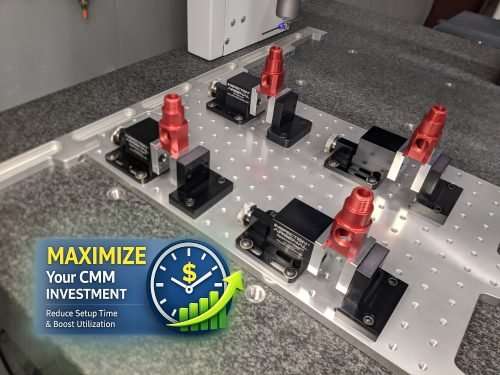
When a repeat job arrives, the fixture is already built and validated. Setup time drops to minutes rather than hours. The inspector secures the fixture, loads the part into the fixture, tightens clamps, and initiates the program.
Benefits of Repeatable CMM Fixturing
- Increased machine utilization
- Higher inspection throughput per shift
- Reduced dependency on individual operator interpretation
- Stable programs that require fewer edits over time
Protecting Long-Term Quality Data With Consistent Setups
Repeatable setups protect the integrity of long-term quality data. Consistent part location and stable alignments ensure historical comparisons reflect actual process performance, not measurement variation. For example, when a trend shows a .0003″ shift over three months, leadership acts with confidence, knowing the measurement method has remained constant.
This level of stability supports:
- Faster root cause analysis
- More accurate process capability assessments
- Stronger audit and customer confidence
- Reduced internal disputes over measurement results
From a financial perspective, this reduces rework, avoids unnecessary process adjustments, and shortens corrective action cycles.
The True ROI of a CMM Investment
For procurement and executive leadership, the results speak for themselves. The true ROI of a CMM investment depends not only on the equipment’s intended capabilities, but on the repeatability and reproducibility of the inspection process surrounding it. A thoughtful and repeatable inspection process increases CMM utilization and increases overall throughput within the business. It converts the inspection lab from a bottleneck into a reliable, scalable asset.
Check out www.inspectionarsenal.com for product information, free CAD model downloads, tools to analyze setup costs with an ROI calculator, or to book a demo with the Inspection Arsenal® team by clicking on the link below. See how you eliminate downtime and deliver perfect parts faster.